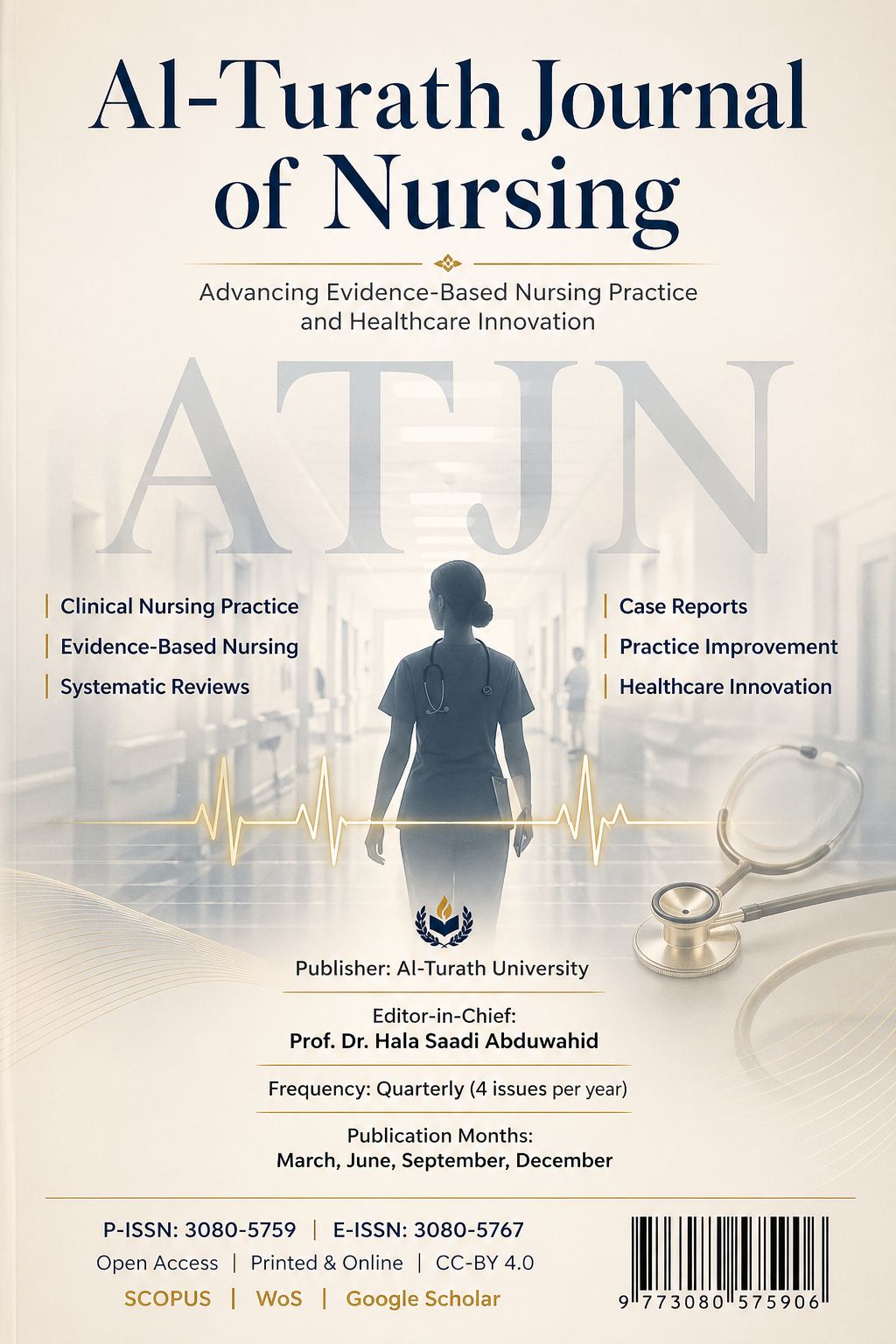
Prevalence, Causes, and Prevention Strategies of Medication Errors in Nursing Practice in Iraqi Teaching Hospitals: A Mixed-Methods Study
DOI:
https://doi.org/10.63964/atnj.2026.2.3Keywords:
Medication Errors; Patient Safety; Nursing; Iraq; Risk Management, Healthcare; Mixed-Methods ResearchAbstract
Background: Medication errors are a leading preventable cause of patient harm worldwide and remain under-characterized in Iraqi teaching hospitals, particularly through approaches that triangulate documented incident data with frontline nurse perspectives. Aim: To estimate the documented prevalence of medication errors and characterize their causes and proposed prevention strategies in three Iraqi teaching hospitals using a mixed-methods approach. Methods: A sequential explanatory mixed-methods study was conducted between October 2024 and February 2026, reporting in line with the Good Reporting of A Mixed Methods Study (GRAMMS) framework [1] and the STROBE statement [2] for the quantitative components. The protocol was prospectively registered (ATU-RIR-2025-09, registered 4 August 2025). Phase 1 was a 12-month retrospective review of all formally reported medication-error incident reports (n = 480) across the medical–surgical, intensive care, and emergency wards of three teaching hospitals (Salah Al-Din, Baghdad, Kirkuk). Each event was classified by stage in the medication-use process (prescribing, transcription, dispensing, administration, monitoring), by error type, by NCC MERP severity index (Categories A–I), and by Reason's Swiss-Cheese contributory factors. Phase 2 was a cross-sectional survey of 350 ward nurses (320 complete responses, 91.4%) using a structured 56-item instrument covering perceived causes, reporting behavior, and prevention strategies. Phase 3 integrated quantitative findings against the nurse-reported causes to produce a hospital-level prevention roadmap. Results: The documented medication-error rate was 8.4 per 1,000 patient-days (95% CI 7.7–9.2). By stage, 41.0% of errors originated in prescribing/transcription, 38.1% in administration, 12.5% in dispensing, and 8.4% in monitoring. Wrong-dose (28.5%), wrong-time (21.0%), and omitted-dose (16.5%) were the most common error types. NCC MERP severity distribution was: Category A–B 30.4%, C–D 56.0%, E–F 11.7%, G–I 1.9% (no fatal events were captured). Nurse-reported leading causes were heavy workload (78.4%), distractions during administration (71.9%), look-alike/sound-alike packaging (68.4%), illegible prescriptions (62.5%), and lack of double-check protocols (54.7%). Of nurses, 52.2% reported having witnessed unreported errors in the prior six months; the principal deterrents were fear of disciplinary action (61.3%) and perceived lack of feedback on submitted reports (54.7%). Conclusion: Medication errors in Iraqi teaching hospitals occur at rates comparable to international benchmarks, with most events of low-to-moderate severity but with substantial under-reporting and a clear concentration of contributory factors at the workload, packaging, prescription-legibility, and double-check-protocol levels. A hospital-level prevention roadmap should prioritize a non-punitive reporting culture, structured double-check protocols for high-alert medications, packaging-driven distinguishability of look-alike products, and protected medication-administration time.
Downloads
Published
Issue
Section
License
Copyright (c) 2026 THIS IS AN OPEN ACCESS ARTICLE UNDER THE CC BY LICENSE http://creativecommons.org/licenses/by/4.0/

This work is licensed under a Creative Commons Attribution 4.0 International License.

This work is licensed under a Creative Commons Attribution 4.0 International License.